DIY Phone Speaker

Boost your tunes and learn some science! We’ll build a DIY phone speaker using common household items. This project is a fantastic way to learn about sound waves, amplification, and the basics of engineering design.

Supplies

  • 1 cardboard tube or paper towel roll
  • 2 paper cups or plastic cups (test the difference)
  • Scissors
  • Pencil
  • Washi tape (optional to decorate)
  • Smartphone

Make a DIY Phone Speaker

Prepare the Tube: Use a pair of scissors to cut a rectangular slit in the center of your paper towel tube. Use the bottom of your phone to trace the opening. This slit should be just large enough to hold your phone securely.

Prepare the Cups: Cut small circular holes in the sides of each cup, big enough for the ends of the tube to fit inside. Trace the end of the cardboard tube on the lower side of each cup to get the right fit. The cups will act as sound amplifiers.

Assemble the Speaker: Insert one end of the tube into the hole in the first cup and the other end into the second cup. Ensure a snug fit, and if needed, use masking or washi tape to secure the tube to the cups.

Test the Sound: Place the base of your phone in the slot on the tube, play some music, and listen! You should notice a significant increase in volume and clarity.

Sound Wave Science

Sound is created when something vibrates. These vibrations move through the air as waves. Think of a wave in the ocean moving up and down — like how sound waves travel, except they move through the air, not water.

When you play music on your smartphone, the speaker creates tiny vibrations that travel through the air in all directions. These sound waves are quite small and spread out quickly, which makes the sound seem quieter.

In this DIY speaker project, we focus on the sound waves by channeling them through paper towel tubes and cups. The tube helps guide the sound waves in one direction instead of letting them spread out. Then, the cups act like amplifiers by bouncing the sound waves inside, making them stronger. As the sound waves bounce and exit the cup, they come out more powerfully, which makes the music sound louder to our ears.

When you listen through your DIY speaker, you hear the sound waves more focused and amplified. This shows how engineers use materials and design to control sound and make it louder or clearer. This kind of science can be found in real speakers, headphones, and even large concert sound systems!

Extension Activities

  • Experiment with Different Sizes: Try using larger or smaller cups to see how the size affects sound amplification.
  • Add Decorations: Customize the speaker with washi tape, paint, or markers to make it uniquely yours while testing if the decorations affect the sound quality.
  • Explore Sound Science: Research different types of speakers and how professional speaker designs utilize similar principles for amplifying sound.


Idea taken from the blog LittleBinsforLittleHands

Dino Fotavtryckskonst

Använd dinosaurie-leksaker för att göra rolig konst. Använd dinosaurier i olika storlekar, olika typer och till och med olika kroppsdelar. Låt dinosaurierna vara din pensel.

Det går ju självklart lika bra att använda några andra djur än dinosaurier.

Och när du ändå är igång – varför inte sätta igång en jakt i naturen runt omkring efter andra spår?

Idén är hämtad från bloggen LittleBinsForLittleHands.

LEGO-Sudoku

Instruktioner till vuxna:

  • Skriv ut sudokubräderna och laminera dem om du vill.
  • Klipp pappren på mitten så att varje tavla är på ett eget papper i A5-format.
  • Det finns tre svårighetsgrader i huvudhusets sudoku: en stjärna, två stjärnor och tre stjärnor.
  • Titta på Häärämös YouTube-kanal för att se hur praktiskt det är att hjälpa ditt barn att lösa sudoku-pussel.

Instruktioner till barn:

  • Räkna hur många rutor av varje färg som finns på spelplanen. Du behöver totalt fyra av varje färg.
  • Om du till exempel har tre blå rutor på brädet, hur många fler behöver du då för att få fyra blå rutor totalt? Ta en blå Duplo-bricka.
  • Placera de Duplo-bitar som du har tagit ovanför brädet i den färgordning som du har valt, så att en färg alltid ligger längst ner (se bilden ovan). För varje Sudoku behöver du 1 till 3 av varje färg.

Lös sudoku:

  • Hitta den rad där endast en färg saknas.
  • När du inte längre kan hitta rader där endast en färg saknas, titta på den stora kvadraten (2 x 2 kvadrat). Vilken färg saknas? Utöver de tidigare lösningsstrategierna kan du ta bort de två färger som saknas i raden eller den stora rutan. Bestäm utifrån de horisontella och vertikala linjerna var färgerna hör hemma.
  • Placera bara en färg på en plats om du är säker på att den hör hemma där. Om du tror att en färg kan placeras i två olika rutor på samma rad, placera den inte än.

Sudoku brädor: LEGO Sudoku (PDF, 244kB)

LEGO-Sudoku

Instructions for adults:

  • Print out the sudoku boards and laminate them if you wish.
  • Cut the papers in half so that each board is on its own A5 size paper.
  • There are three levels of difficulty in the main house sudoku: one star, two stars and three stars.
  • Watch the Häärämö YouTube channel to see how handy it is to guide your child to solve sudoku puzzles.

Guide for your child:

  • Count how many squares of each colour are on your game board. You need a total of four of each of the four colours.
  • For example, if you have three blue squares on your board, how many more do you need to make four blue squares in total? So take one blue Duplo piece.
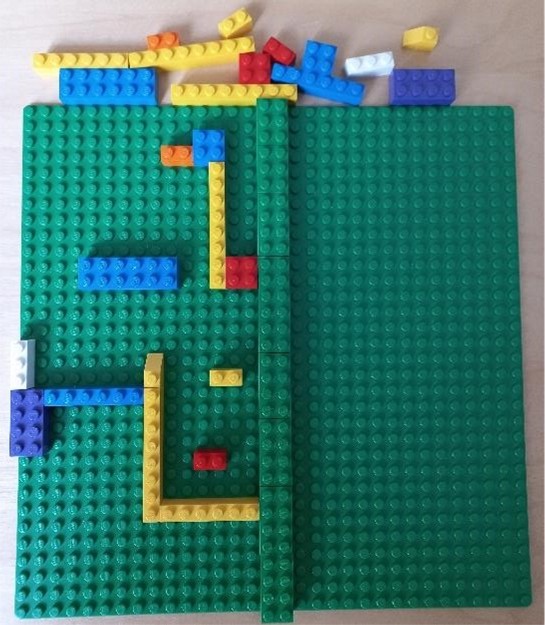
  • Place the Duplo pieces you have taken above the board in the colour order you have chosen, so that one colour is always at the bottom (see picture above). For each Sudoku, you will need 1 to 3 of each colour.

Solve the sudoku:

  • Find the row with only one colour missing.
  • When you can no longer find rows with only one colour missing, look at the large square (2 x 2 square). Which colour is missing? In addition to the previous solution strategies, take aside the two colours that are missing from the row or the large square. Decide from the horizontal and vertical lines where the colours belong.
  • Only put a colour in place if you are sure that it belongs there. If you think a colour can be placed in two different squares on the same row, don’t place it yet.

Sudoku boards: Lego-sudoku Eng (PDF, 117 kB)

Magnet målning

Material som behövs

  • Magnetstav
  • Olika metallföremål som kullager, fjädrar och skruvar
  • Olika föremål som inte är metall, som kulor
  • Papper
  • Plastbricka eller låda
  • Temperafärg
  • Koppar eller palett att doppa metallbitarna i
  • Skedar för att få ner de målade täckta bitarna i lådan.

Magnet målning hur man gör

För att börja måla, häll din färg i något tillräckligt djupt för att släppa dina metallbitar i.  En äggkartong fungerar bra.

Klipp sedan papperet så att det passar facket och lägg en bit inuti.

Nu är det dags att måla! Doppa en metallbit i färg och släpp den i brickan. Ta sedan magnetstaven och flytta runt den under plastbrickan eftersom detta håller metallbitarna rullande smidigt.

Tid för experimenterande

En av de bästa delarna av det här projektet är att barnen kan lära sig lite naturvetenskap medan de målar. Du kan använda bara metallbitar, eller så kan du slänga i några saker som magneten inte kan flytta som glaskulor. Även olika metalldelar rör sig på olika sätt.


Idén tagen fråm bloggen LeftBrainCraftBrain

Magnet Painting

Supplies Needed 

  • Magnet wand 
  • Various metal items like ball bearings, springs & screws 
  • Various non-metal items like marbles 
  • Paper 
  • Plastic tray or box (I used an old 9 x 13 food container) 
  • Tempera paint. 
  • Cups or palette to dip the metal pieces in 
  • Spoons to get the painted covered pieces into the tray. 

Magnet Painting How-To 

To begin painting, pour your paint into something deep enough to drop your metal pieces into.  An egg carton works well. Then cut your paper to fit your tray and place a piece inside. Now it’s time to paint! Dip a metal piece in paint and drop it into the tray. Then take the magnet wand and move it around under the plastic tray as this keeps the metal pieces rolling smoothly. 

Time for Experimentation 

One of the best parts of this project is that kids can learn a little science while painting. You can use all metal pieces, or you can throw in some things that the magnet can’t move like glass marbles. Even different metal pieces move differently. 


The idea is taken from the blog LeftBrainCraftBrain

Matteduell

Spel för att träna antal, addition och tal-kompisar.

Skriv ut två uppsättningar per spel av korten. Klipp ut dem innan ni kan spela. För högre hållbarhet laminera gärna

  • Välj fyra kort som ska ligga framför spelarna
  • Eleverna står eller sitter mitt emot varandra. Händerna lägger de framför sig på bordet.
  • Det går även att spela spelet liggandes på magen med korten liggande lite framför spelarna som på det sättet måste lyfta överkroppen och armarna för att nå korten.

För varianter och färdiga kort att skriva ut:

Matteduell (PDF, 101kB)