
Introduction
Have you ever wondered what happens to the heart as we exercise intensely? How does its beating change? A doctor can figure this out by using a tool called a stethoscope, which is a long, thin plastic tube that has a small disc on one end and earpieces on the other end. In this activity, you will make a homemade stethoscope and use it to measure peoples’ heart rates at rest and after exercising.
Materials
- Duct tape or other strong tape
- Scissors
- Plastic funnel
- A cardboard tube from a paper-towel roll
- Stopwatch or clock that counts seconds
- A volunteer who can safely exercise intensely for one minute
Procedure
- Put the narrow end of the funnel into the cardboard tube.
- Using a strip of duct tape or other strong tape, tape the funnel and cardboard tube together. Make sure there are no gaps or spaces where you tape them together.
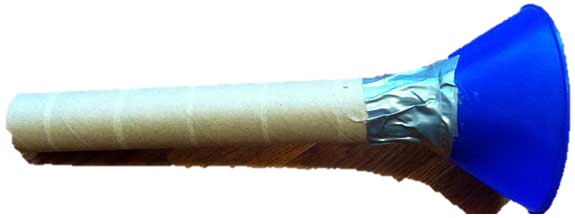
- Your stethoscope is now ready to use! Practice listening to the heartbeat of a volunteer by putting the funnel on the left side of the volunteer’s chest. Make sure the funnel is flat against their chest. Put your ear against the hole at the end of the cardboard tube. Do you hear the heartbeat?
- Tip: If it is noisy or the volunteer is wearing thick clothing, it may be hard to hear the heartbeat, so you may need to adjust conditions accordingly.
- After the volunteer has been resting in a chair for a few minutes, listen to the heartbeat and count how many times it beats in 10 seconds.
- Multiply this number by six. This is the resting heart rate of the volunteer in beats per minute (bpm).
What is the volunteer’s resting heart rate? - Ask the volunteer to exercise in place for one minute by doing jumping jacks or running in place. Right after the volunteer has stopped exercising, listen to the heartbeat and count how many times it beats in 10 seconds.
Why do you think you count heartbeats for only 10 seconds? What happens if you count for a longer period of time after exercising? - Multiply this number by six. This is the heart rate right after exercising in bpm.
What is the volunteer’s heart rate now? How did the heart rate change after exercise? Why do you think it changed like it did? - Think about how regularly exercising may change a person’s heart. If a person regularly exercised, how do you think this would change his or her heart rate? How do you think that person’s heart rate during rest and exercise would be different?
What Happened?
When people exercise, their bodies need more oxygen, and consequently their hearts beat faster and their heart rates increase. This is why you most likely found that when your volunteer exercised, the heart rate increased compared to the resting heart rate. In addition, genetics, gender, age, and health all affect people’s heart rates. The heart rates in people who exercise regularly usually will not increase as much during exercise. Regular exercise strengthens the heart so that it does not need to work as hard to do the same amount of exercise.
While you can determine someone’s resting heart rate by counting the number of beats in 15 seconds and multiplying by four to get the beats per minute (bpm), to calculate a heart rate immediately after exercise it is better to count the number of beats for 10 seconds and multiply that value by six (to get the bpm). Because the heart will quickly slow down after exercise, the heart rate should be measured immediately after a person has stopped exercising (or while they exercise, if possible).