
Materials Needed:
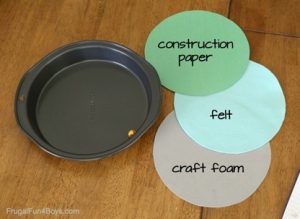
- A round cake pan
- A marble
- Construction paper
- Felt or a similar fabric
- Craft foam
- Sand paper
Implementation
Step 1: Tap the marble so that it rolls around the perimeter of the cake pan. Kids will want to try this several times before getting serious about the experiment because it’s fun to do!
Practice launching the marble with an equal amount of force each time. Then count how many times it travels around the pan before it stops. We found that it worked well to start the marble next to the hole in our pan’s rim. That made it easy to count revolutions. Each time the marble went past the hole, we counted another trip around.
Step 2: Now test different surfaces to see how the amount of friction affects the marble. The cake pan itself has very little friction.
Try a piece of construction paper first. Trace the bottom of the pan on a sheet of construction paper and cut it out. Then lay the construction paper circle in the bottom of the pan. Launch your marble around the pan again. How many times around did it travel this time?
We tested construction paper, felt, and craft foam. Sand paper is also a great surface to test! Use what you have around the house. Any fabric will work if you don’t have felt.
Theory and Questions to Discuss
Newton’s first law of motion says that an object in motion will stay in motion unless acted on by an outside force. Friction is a force which slows down motion by preventing objects from sliding past each other.
- Which surface had the most friction in your experiment?
- Which one slowed the marble down the fastest?