
Introduction
Have you ever wondered why salt is used to de-ice roads? Did you know that snow sticks more readily to pavement that has been treated with salt? Why would this be the case? In this activity, you will use the same principles to hoist ice cubes with a piece of string. Is it possible to do this without getting your hands cold? Try the activity and see what a pinch of salt can do!
Materials
- Four glasses
- Cold water
- Ice cubes
- Salt
- Four pieces of string, each about 20 centimeters long (yarn works well.)
- Two sticky notes
- Watch or timer
- Thermometer (optional)
Prep Work
- Gather all of your materials on a work surface that can tolerate spills.
- Fill all four glasses with cold water.
- Put a few ice cubes in each glass of water. They will float because ice is less dense than water.
Procedure
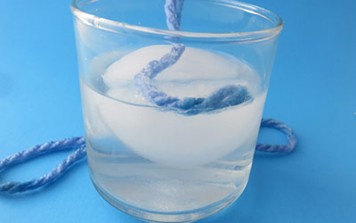
- Find an ice cube with a surface at water level. Lay one end of a piece of string across that ice cube.
Do you think the ice will stick to the string? - Lift the string.
Does the ice cube stick to the string? Why do you think this is the case? Can you think of a way to lift the ice cube with string without touching the cube? - Try again with the second glass, but now, sprinkle some salt over the string and ice cube. Mark this glass with a sticky note.
Do you think the ice will stick to the string if you lift it? - Lift the string.
Does the ice cube stick to the string? What do you think would happen if you left the ice cubes out for a few minutes with the strings on top? - Take the other two glasses filled with water and ice cubes.
- For both glasses, lay one end of a piece of string across an ice cube with a surface at about water level; let the other end of the string hang over the edge off the glass.
- Sprinkle salt over the string and ice cube in one of the glasses and mark this glass with a sticky note. Wait two to three minutes.
Do you think the ice will stick to the string after you give it some time? Will both ice cubes, just one ice cube or no ice cubes stick? Why? - After about two to three minutes, lift one string at a time.
Can either string pick up the ice cube? Can you explain what you see? - If you cannot pick up any ice cubes, try again, but wait a little longer this time.
What Happened?
Could you lift the ice cube you had sprinkled with salt and left untouched for a few minutes? Did you fail to pick up the cube in all other cases? Why does this happen? First, the ice around the string melts when you sprinkle it with salt. Then, the string freezes to the ice cube.
When you sprinkle salt over ice, it dissolves into the thin layer of water above the ice. Because salt water freezes at a lower temperature than pure water, adding the salt makes some ice melt and absorb heat in the process. The area around it thereby cools and freezes water molecules to the ice cube, also freezing the string onto the cube. Without the salt, the water and ice remain at the same temperature and the string does not freeze to the ice. In both cases, the ice cube gradually melts as it absorbs heat from the air around it, but without the salt, the string cannot freeze to the cube.
If you used sugar, you would see the same effect: the cube sticks to the string. Dissolving other substances in water will also lower the freezing point and create the same effect.